ENG
ENG
 English
 русский
 中文简体
中文简体 Español
 Indonesia
Where Fin Geometry and Frame Rigidity Decide Equipment Lifespan
Industrial equipment fails less often from electrical faults than from heat that has nowhere to go and frames that flex under repeated load. Extruded aluminum solves both problems from the same billet, because the process that shapes a cooling fin is the same process that shapes a structural rail. The difference lies entirely in the die design, wall thickness, and surface geometry that a manufacturer chooses for a given application.
This distinction matters more than it first appears. A profile optimized for airflow around dense fins behaves very differently under mechanical stress than a profile optimized for bolt-slot rigidity. Engineers who understand where each geometry excels can specify the right part on the first attempt instead of over-engineering an assembly with oversized stock.
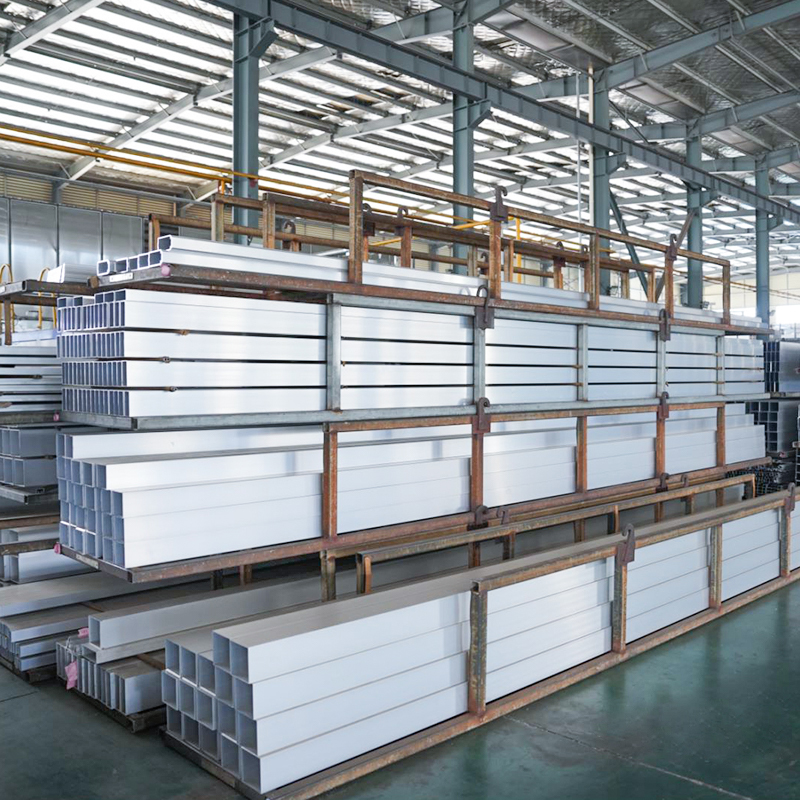
Two families of profile dominate industrial specification sheets. The first is the radiator family, shaped with dense arrays of thin fins to maximize surface area for passive or forced-air heat exchange. The second is the framing family, built around square, rectangular, or slotted cross sections that prioritize stiffness, modularity, and bolt-together assembly. A well-designed enclosure or cooling system typically draws from both families at once.
Comparing Fin Geometries: Serrated Radiator vs Sunflower Radiator
The serrated radiator profile arranges narrow, saw-toothed fins along a flat spine. The serration breaks up the boundary layer of air moving across each fin, which improves convective heat transfer compared with a plain straight fin of the same height. This geometry is common in linear LED fixtures, motor drive enclosures, and compact power supplies where the mounting footprint is fixed and airflow is largely passive.
The sunflower radiator profile instead radiates fins outward from a central core, resembling the seed pattern that gives it its name. This layout increases the perimeter-to-diameter ratio and works well with a central mounting bore, which is why it is frequently selected for cylindrical or bulb-style heat sources such as high-bay lighting and compact motor casings.
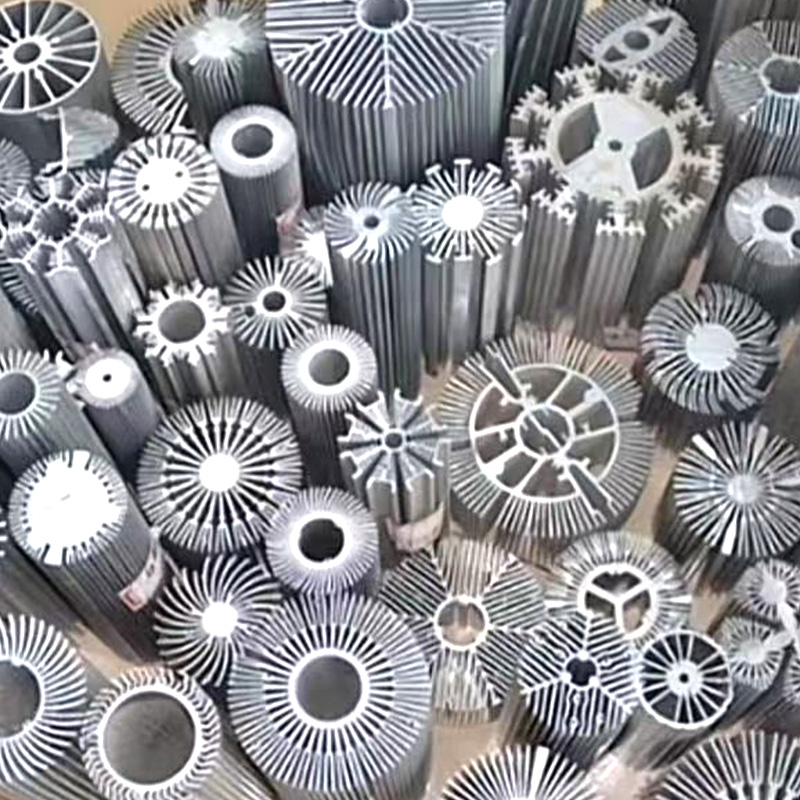
Surface area per unit length is the single clearest way to compare the two geometries, since it correlates directly with how much heat a passive design can shed before active cooling becomes necessary. The chart below sets both profiles against a plain flat-fin reference of similar overall height.
Exposed Surface Area per Meter of Profile Length
The sunflower geometry gains roughly a quarter more surface area than the serrated layout at the same nominal envelope, but that gain comes with a tradeoff: the radial fin arrangement is harder to combine with flat-panel mounting hardware, while the serrated profile mounts flush against a heat-generating board with minimal adaptation.
How 4040 and 4080 Framing Profiles Support Load-Bearing Assemblies
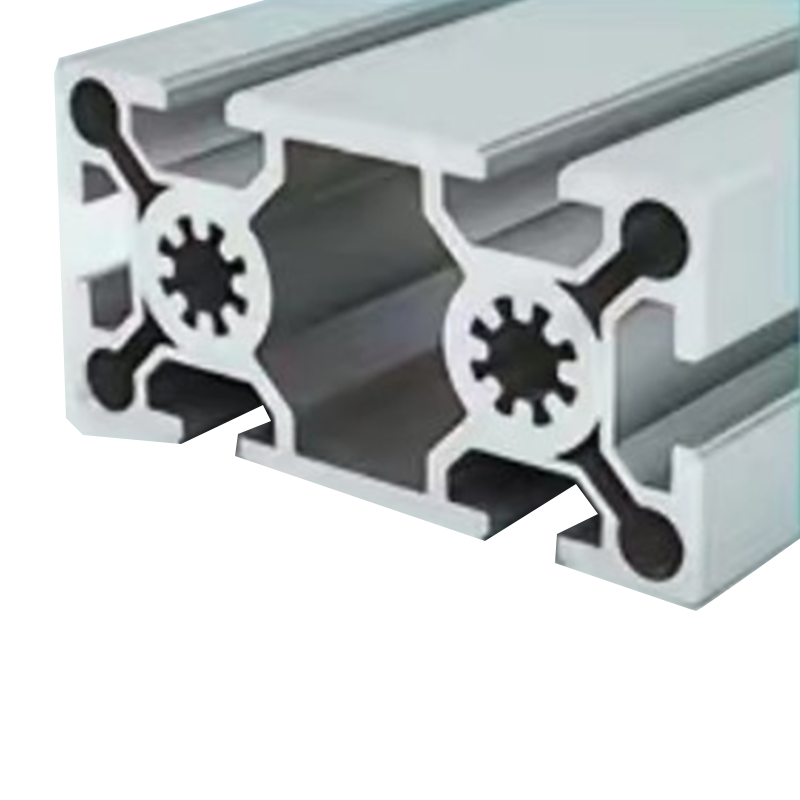
Moving from cooling to structure, the 4040 flow aluminum wire profile is a square T-slot section measuring 40mm on each side, built for modular workbenches, conveyor frames, and machine guarding where components need to slide and lock into position along the slot channel. Its balanced cross section keeps deflection low across moderate spans while remaining light enough for manual handling during assembly.
The 4080 wide rectangular tube extends that same slot system into a 40mm by 80mm rectangular section. The added width along one axis significantly raises the section modulus in that direction, which is why it becomes the default choice for long horizontal beams, gantry rails, and any span that would otherwise sag under its own weight when built from square stock alone.
| Profile | Cross Section | Slot Width | Typical Span Use |
| 4040 profile | 40mm x 40mm | 8mm T-slot | Up to 1.2m unsupported |
| 4080 profile | 40mm x 80mm | 8mm T-slot | Up to 2.4m unsupported |
| Square tube | 40mm x 40mm solid wall | None | Fixed brackets and enclosures |
Approximate Static Load Capacity, kg per Meter Span
These figures illustrate a general pattern rather than a certified rating for any specific installation, since actual capacity depends on wall thickness, support spacing, and fastening method. The comparison nonetheless makes the sizing logic clear: reach for the 4080 section whenever a run needs to clear more than about two meters without an intermediate support post.
Why Aluminum Square Tube Remains the Default Choice for Custom Frameworks
The aluminum square tube differs from the T-slot profiles above in one key respect: it has no built-in channel system. That absence is an advantage in its own right for fabricators who weld, rivet, or use external brackets rather than sliding hardware, since a solid-wall tube resists torsional twisting slightly better than a slotted section of the same outer dimension.
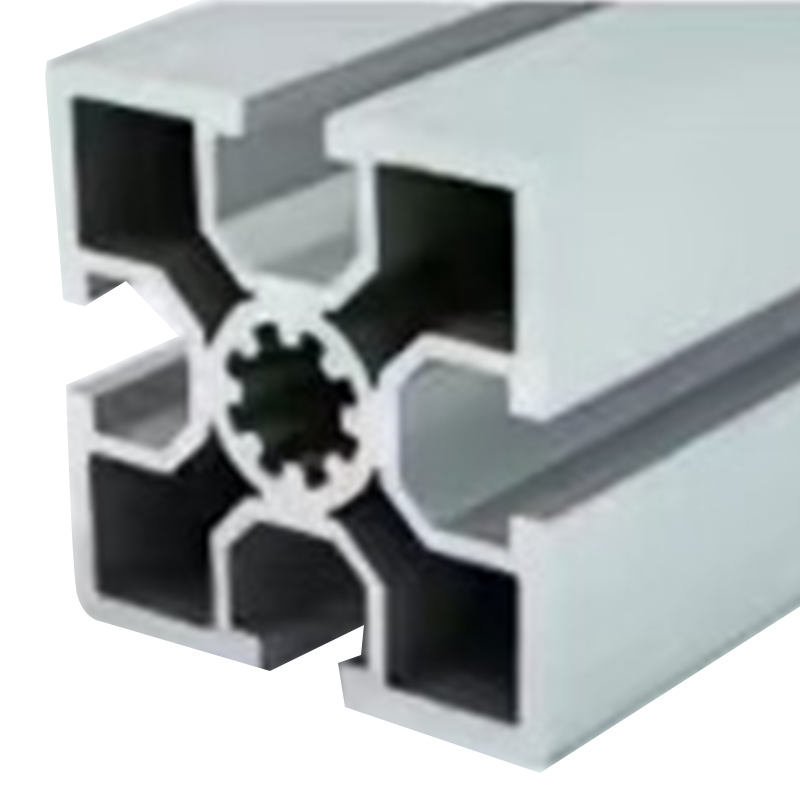
Square tube shows up constantly in furniture legs, protective guarding, signage frames, and light-duty machine bases where the design calls for a clean, uninterrupted surface rather than a visible slot line. Because the wall is continuous, it also machines and paints more predictably than a T-slot profile, which is one reason architectural and retail fixture designers favor it even outside factory settings.
A tube wall thickness increase from 1.5mm to 2.0mm on a standard 40mm square section raises torsional resistance by a meaningful margin without materially increasing the finished part weight, which is why wall gauge selection deserves as much attention as outer dimension when specifying stock.
Manufacturing all five of these profile families starts from the same billet-to-finished-bar sequence. Understanding that sequence explains why lead times and minimum order quantities behave the way they do across a supplier's catalog.
Extrusion Production Flow, Billet to Finished Profile
Tracking Thermal Dissipation Across a Cooling Cycle
Static surface area is a useful proxy for radiator performance, but the more practical measure for an engineer sizing an enclosure is how fast a given profile pulls a heat source back toward ambient temperature once the load is removed. Passive cooling curves for the serrated and sunflower profiles diverge noticeably after the first few minutes.
Surface Temperature During a 30-Minute Passive Cooldown
Both curves start from the same 85C baseline, yet the sunflower radiator settles closer to ambient within the observed window because its radial fin arrangement exposes more edge surface to convective air movement. The serrated profile still cools steadily, which is sufficient for enclosed fixtures where a slightly higher steady-state temperature remains within the component rating.
Balancing Load, Modularity, and Cost Across Framing Profiles
Choosing between 4040, 4080, and square tube stock rarely comes down to one variable alone. The radar comparison below scores each profile across five practical criteria on a zero to ten scale, based on typical fabrication outcomes rather than a single certified test.
Framing Profile Comparison Across Five Criteria
The 4080 profile leads clearly on load capacity, which matches its role as a beam-grade section, while the 4040 profile scores highest on modularity and assembly speed because its lighter mass and familiar slot spacing make it faster to reconfigure. Square tube trades some modularity for the best cost efficiency of the three, since a solid section without a T-slot channel is generally less expensive to produce at equivalent wall thickness.
Matching Profile Types to Application Requirements
The table below condenses the comparisons above into a quick reference for specifying stock at the design stage, grouped by the problem each application is trying to solve rather than by profile name alone.
| Application | Primary Concern | Recommended Profile |
| Linear LED or drive enclosure | Flat-mount passive cooling | Serrated radiator |
| Cylindrical light or motor housing | Maximum radial surface area | Sunflower radiator |
| Workbench or short conveyor frame | Fast reconfiguration | 4040 profile |
| Long gantry rail or beam | Minimal sag over span | 4080 profile |
| Welded guard or fixture frame | Continuous clean surface | Square tube |
Frequently Asked Questions About Extruded Aluminum Radiator and Framing Profiles
Q1: What is the main functional difference between a serrated radiator and a sunflower radiator?
A serrated radiator uses a flat spine with saw-toothed fins suited to flush board mounting, while a sunflower radiator arranges fins radially around a central bore for cylindrical heat sources.
Q2: When should a 4080 profile be used instead of a 4040 profile?
The 4080 profile is better suited to spans beyond roughly two meters where sag or deflection under load becomes a concern, since its added width raises stiffness along that axis.
Q3: Is aluminum square tube stronger than a T-slot profile of the same size?
A solid-wall square tube generally resists torsional twisting slightly better than a slotted profile of equal outer dimension, though it lacks the sliding hardware channel that T-slot systems offer.
Q4: Does anodizing or powder coating affect thermal performance?
A properly applied thin anodized or coated finish has only a minor effect on heat dissipation and is commonly used for corrosion resistance and appearance without meaningfully reducing cooling performance.
Q5: What alloy is typically used for these extruded profiles?
6063-series aluminum alloy is the most common choice for both radiator and structural framing profiles because it extrudes cleanly and offers a practical balance of strength and thermal conductivity.