ENG
ENG
 English
 русский
 中文简体
中文简体 Español
 Indonesia
Structural Demands in Next-Generation Vehicle Architectures
The shift toward electrified and modular vehicle platforms has redefined the mechanical requirements for enclosure systems. Battery trays must resist torsional loads while maintaining thermal stability; heavy-duty access doors require repeated impact resistance without fatigue. Conventional steel solutions add mass, while standard 6xxx alloys often lack the specific strength-to-weight ratio needed for these dual-use applications. Advanced new energy vehicle battery shell floor aluminum profile designs now integrate closed-cell ribs and integrated cooling channels, directly addressing thermal management and crashworthiness in a single extrusion.
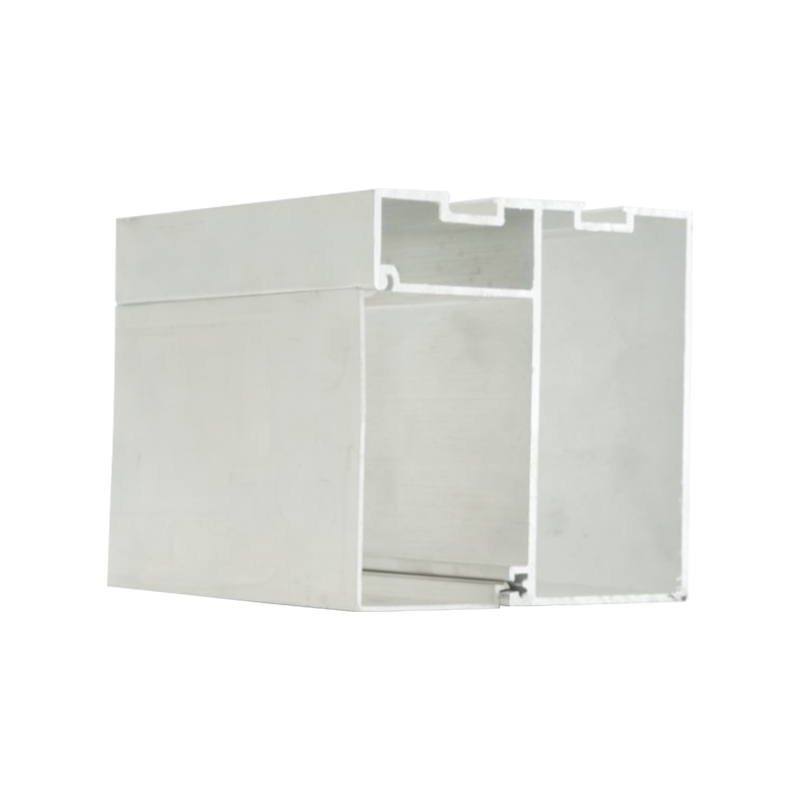
For mobile industrial equipment and commercial vehicle entry systems, telescopic door aluminum profile solutions must exhibit precise dimensional stability over long stroke lengths. The extrusion process controls grain flow to minimise warpage, enabling smooth telescoping action even under side loads. Simultaneously, sleeve-type aluminum profile constructions offer modular assembly for battery frame side rails, allowing quick adaptation to different cell-to-pack configurations without retooling entire dies.
Material Selection & Performance Trade-Offs
High-strength 6xxx and 7xxx series alloys dominate this segment. The table below summarises typical mechanical properties for extrusions used in battery housings and heavy-duty sliding mechanisms, based on T6 temper conditions.
| Alloy | Yield (MPa) | UTS (MPa) | Elongation % | Fatigue limit (MPa) |
|---|---|---|---|---|
| 6061-T6 | 240 | 290 | 12 | 95 |
| 6005A-T6 | 215 | 260 | 10 | 85 |
| 6082-T6 | 250 | 310 | 8 | 100 |
| 7003-T6 | 280 | 340 | 8 | 115 |
| 7075-T6 | 430 | 510 | 7 | 150 |
While 7075 offers the highest strength, its extrusion complexity and stress-corrosion sensitivity often steer designers toward 6082 or 6005A for complex hollow sections. For new energy vehicle battery shell floor aluminum profile applications, 6082 provides an optimal balance between weldability, corrosion resistance, and extrudability, especially when thin-wall stiffening ribs are required.
Process Influence on Final Properties
Precision extrusion involves billet preheating, die design, quenching, and artificial ageing. The cooling rate after extrusion directly affects the Mg₂Si precipitate distribution, which governs yield strength. For telescopic door aluminum profile sections, uniform cooling along the length is critical to avoid twist, which would impair sliding fit. The chart below illustrates how quench rate influences hardness for a typical 6xxx alloy.
Rapid quenching (above 100 °C/s) retains supersaturated solid solution, enabling peak ageing. However, for thick-walled sleeve-type aluminum profile sections, the core cools slower than the surface, leading to property gradients. Advanced water-spray and air-quench systems now mitigate this, achieving through-thickness hardness variation below 8 HBW.
Comparative Performance: Battery Floor vs. Door Profiles
Although both belong to the automotive extrusion family, the design priorities differ. Battery floors demand high bending stiffness and energy absorption, while door profiles require wear resistance and low friction. The radar chart below contrasts five key criteria (normalised) for typical new energy vehicle battery shell floor aluminum profile versus telescopic door aluminum profile solutions.
Battery floors prioritise stiffness and energy absorption (for crash pulses), while door profiles emphasise wear resistance and extrudability due to complex sliding geometries. The sleeve-type aluminum profile often serves as an intermediate solution, balancing corrosion resistance with moderate mechanical demands.
Design for Extrusion: Section Complexity & Wall Thickness
Modern extrusion presses (up to 100 MN) can produce profiles with circumscribed circle diameters exceeding 400 mm. However, complexity adds cost. The chart below shows relative die cost and extrusion speed for different section types, based on industry data from multiple European extruders.
Solid profiles (e.g., simple flat bars) are cheapest but offer minimal design flexibility. For new energy vehicle battery shell floor aluminum profile, multi-void sections with integrated cooling channels increase die cost by 40-60%, but reduce assembly steps by eliminating separate cooling tubes. telescopic door aluminum profile designs typically fall into semi-hollow or hollow categories, requiring careful bridge design to maintain tongue strength during extrusion.
Fatigue and Cyclic Performance
Heavy-duty doors and battery enclosures experience cyclic loading: door openings/closings and battery module expansion/contraction during thermal cycling. The S-N curve below shows typical fatigue behaviour for 6082-T6 extrusions under bending loads, relevant to both applications.
At 10⁶ cycles, the endurance limit for 6082-T6 is approximately 95 MPa. For sleeve-type aluminum profile used in battery frame side members, designers often adopt a safety factor of 1.5, limiting operational stress to 65 MPa to ensure long-term durability in EV applications where thermal gradients amplify fatigue damage.
Joining and Assembly Considerations
Extrusions are rarely used in isolation. Battery housings employ friction stir welding (FSW) and laser welding to join floor profiles to side rails. For telescopic doors, mechanical fastening and slide bearings are common. The flow chart below outlines typical manufacturing sequence for a battery tray using new energy vehicle battery shell floor aluminum profile.
FSW eliminates porosity issues common in MIG welding of 6xxx alloys, while laser welding offers high-speed joining for thin-walled telescopic door aluminum profile assemblies. For sleeve-type aluminum profile used in modular frames, bolted connections with steel inserts are often preferred to allow disassembly for battery service.
Surface Treatment and Corrosion Protection
Aluminium extrusions rely on anodising or conversion coatings for corrosion resistance. For battery housings, a chromate-free Ti-Zr conversion layer (thickness 0.5-1.0 µm) combined with cathodic electrophoretic coating (ED) is common. The bar chart below compares typical coating thickness requirements for different service environments.
For new energy vehicle battery shell floor aluminum profile, underbody exposure demands 18-22 µm ED coating, while interior telescopic door aluminum profile may only require 8-12 µm anodising. sleeve-type aluminum profile used in assembly line frames often receives a clear anodic coating of 15 µm for abrasion resistance.
Frequently Asked Questions
Q1: What is the main advantage of using aluminum extrusions for battery housings over stamped steel?
Aluminum extrusions allow integrated functionality—cooling channels, mounting rails, and impact beams can be formed in a single profile, reducing part count and assembly complexity. Additionally, the specific stiffness (E/ρ) is about three times higher than steel, enabling lighter structures with equal bending rigidity.
Q2: How do telescopic door profiles maintain dimensional accuracy over long lengths?
Precision extrusion with controlled cooling rates and stretch straightening limits twist and bow to within 0.5 mm per meter. For critical sliding surfaces, post-extrusion machining or drawing can achieve H11 tolerances, ensuring smooth telescoping action without binding.
Q3: Can sleeve-type profiles be used for both battery frames and door systems?
Yes, the sleeve geometry offers modularity. For battery frames, sleeve profiles act as side rails that accept end plates; for heavy doors, they serve as structural carriers for roller assemblies. The wall thickness and alloy choice are adjusted per application—typically 3-5 mm for battery, 2-3 mm for doors.
Q4: What alloys are recommended for high-cycle fatigue applications like bus doors?
6082-T6 is widely used due to its good fatigue strength (endurance limit ~95 MPa) and weldability. For higher strength, 7003-T6 offers 115 MPa endurance limit but requires careful corrosion protection. The choice depends on the expected cycle count and environmental exposure.
Q5: How does extrusion direction affect the mechanical properties of battery floor profiles?
Extrusion creates a grain flow direction that enhances longitudinal strength but reduces transverse properties. For battery floors, designers often orient the extrusion length along the vehicle's longitudinal axis to maximise crash performance, while transverse ribs are added for local stiffness.