ENG
 English
 русский
 中文简体
 Español
 Indonesia

Your drawing calls for aluminum tube stock, and the supplier asks one question before sending a quote: square or rectangular? It is not a routine check. Both shapes are closed hollow extrusions produced on the same presses and supplied in the same 6063 and 6061 alloys, yet the geometry changes stiffness, buckling, joining effort, and visual appearance. The deciding rule is simple. If the main load will bend the member in a single plane, a rectangular tube delivers more stiffness for the same weight. If loads can arrive from several directions, or the member must stand as an unsupported column, a square tube is the safer, more symmetrical choice.
Square and Rectangular Aluminum Tube: Reading the Dimensions
Closed aluminum tube sizes are written as width x height x wall thickness. A 40 x 40 x 2 tube is square: 40 mm wide, 40 mm high, with a 2 mm wall. A 40 x 80 x 2 tube is rectangular: 40 mm wide, 80 mm high, with the same 2 mm wall. In both cases the inner cavity equals the outer dimension minus twice the wall thickness, and the extrusion die leaves small radiused corners at each inside edge.
Both shapes come from the same hot extrusion process: a heated 6xxx-series billet is pushed through a steel die fitted with a mandrel that forms the hollow bore. Tolerances follow the same standard family, ASTM B221, EN 755, or GB/T 6892, and the wall can be identical on every side. The practical differences between square and rectangular tube therefore come from geometry rather than material.
| Tube Shape | Common Sizes (mm) | Typical Applications |
|---|---|---|
| Square tube | 25 x 25, 40 x 40, 50 x 50, 80 x 80 | Furniture legs, rack posts, machine frames, balustrades |
| Rectangular tube | 20 x 40, 30 x 60, 40 x 80, 50 x 100 | Beams, stringers, gate leaves, conveyor frames |
| Round tube | 20, 25, 32, 40, 50 OD | Handrails, columns, rollers, bushing stock |
Round tube is the natural reference point. A round section has equal stiffness in every direction and the smallest surface area for a given cross-section, but it is the hardest member to join at right angles. Square and rectangular tubes trade a little of that radial efficiency for flat faces that bolt, weld, and butt together cleanly.
 Aluminum Round Tube with Equal Stiffness in All DirectionsThis round tube offers uniform bending strength and excellent corrosion resistance, making it a reliable baseline for comparing square and rectangular profiles in structural applications.View Product →
Which Is Stronger: Rectangular or Square Aluminum Tube?
The honest answer is that neither shape is globally stronger; strength depends on the loading direction. Two common profiles make this clear: a 50 x 50 x 2 mm square tube and a 30 x 70 x 2 mm rectangular tube. Their cross-sectional areas are both 384 mm², so each weighs about 1.04 kg/m and costs about the same per metre. What changes is how the material sits relative to the bending direction.
The moment of inertia, the property that controls deflection, is 234,592 mm⁴ for the rectangular tube about its strong axis against 147,712 mm⁴ for the square tube, roughly 59% more. Under the same load, with the tall side vertical, the rectangular member sags about 37% less. About the weak axis the picture reverses: the square tube is more than twice as stiff, and because both axes of a square are identical, it remains equally stiff at every rotational position.
| Property | 50 x 50 x 2 Square | 30 x 70 x 2 Rectangular |
|---|---|---|
| Cross-sectional area | 384 mm² | 384 mm² |
| Nominal weight per metre | 1.04 kg/m | 1.04 kg/m |
| Moment of inertia, strong axis | 147,712 mm⁴ | 234,592 mm⁴ |
| Moment of inertia, weak axis | 147,712 mm⁴ | 60,832 mm⁴ |
| Minimum radius of gyration | 19.6 mm | 12.6 mm |
For columns, the last row of the table matters most. A free-standing column buckles around its weakest axis, so the rectangular tube is limited by its 12.6 mm radius of gyration, while the square tube offers 19.6 mm in every direction. The square column will carry a noticeably higher axial load before sideways buckling becomes the controlling mode. If the rectangular member is braced in the weak direction, for example bolted to a wall or framed into a deck, it can still work as an efficient column.
When Rectangular Aluminum Tube Is the Right Choice
Choose a rectangular section any time the load path is known and the member works mostly in one plane.
- Horizontal beams and spans: sills, lintels, handrail strings, trailer cross-members, and shelf supports perform best with the tall dimension oriented vertically.
- Height-sensitive frames: a 20 x 40 tube on edge provides depth in one plane while keeping a slim 20 mm face for tracks, datum surfaces, and finished screens.
- Planar assemblies: door leaves, gates, solar panel frames, and space frames benefit from the wide face as a mounting surface for panels and infill.
- Material economy: for a one-directional span, a rectangular section reaches the required stiffness with less aluminum than a square tube of equal wall thickness.
Rule of thumb: if you can draw an arrow showing the main load direction and that arrow never turns 90 degrees, a rectangular tube is usually the lighter, stiffer answer.
When Square Aluminum Tube Is the Right Choice
Square tube takes over when one member has to serve several roles in the same structure.
- Vertical posts and legs: equal buckling resistance in every direction makes 40 x 40 and 50 x 50 the standard section for workbench legs, display stands, handrail posts, and pergola supports.
- Multi-directional frames: carts, racks, machine guards, and gate frames receive loads from the top, front, and sides; a square section treats every plane on equal terms.
- Bolted and bracket assemblies: identical faces mean standard brackets, corner fittings, and bolt patterns line up without flipping the profile three times to find the right orientation.
- Exposed structures: deliberate symmetry reads well in architectural details, especially with a clean anodized finish.
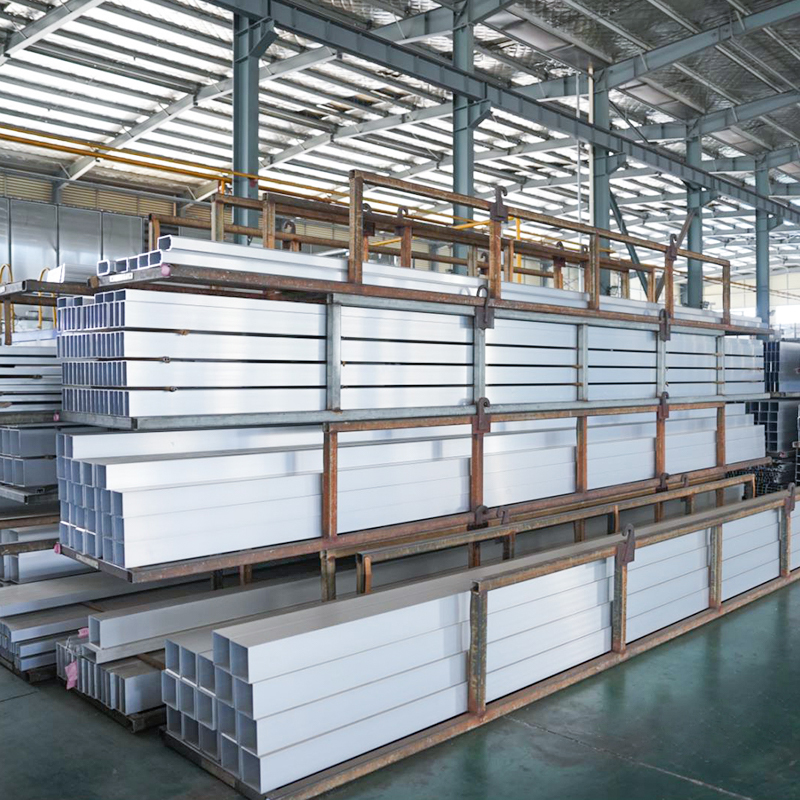 Aluminum Square Tube for Versatile Structural FramingThe square cross-section provides flat faces for easy joining and works well when one member must handle multiple roles, offering a balance of strength and aesthetic flexibility.View Product →
Keep the wall-thickness decision separate from the shape decision. A heavier wall in a square section often beats a lighter rectangular section when the loading direction cannot be guaranteed.
Cutting, Welding, and Fastening: Differences That Show Up in the Shop
Fabricators feel the difference between square and rectangular tube in three places: mitering, welding heat, and hole patterns.
- Mitering and notching: square tube cuts at the same 45-degree miter on all four faces, so corners mate without tracking orientation. A rectangular tube demands constant attention so the wide and narrow faces land on the correct side of the joint.
- Welding: square tube spreads welding heat evenly across four equal walls. Rectangular tube concentrates heat on the two wide walls, so thin walls on sections such as 40 x 120 need lower amperage or stitch welding to avoid distortion.
- Fasteners and fittings: through-bolts, spring nuts, and press-in end caps seat most reliably on square faces. A rectangular tube usually forces you to design around two wide faces and two narrow faces, limiting where hardware can sit.
Corner radius is the detail that buyers forget. The extrusion die leaves an internal radius of roughly 1.5 to 3 mm depending on profile size. If an end cap must press in or an insert must slide through, ask for the exact internal radius; a difference of 2 mm can make a component refuse to fit.
Alloy and Temper: The Shape Is Not the Whole Story
Square and rectangular tubes are stocked mainly in 6063-T5 and 6061-T6. 6063-T5 is softer, extrudes into finer details, takes anodizing beautifully, and is the normal choice for doors, windows, curtain walls, and decorative frames. 6061-T6 is heat treated to a typical minimum yield strength of 240 MPa and suits load-bearing frames, racks, and transport equipment.
Before fixing the wall thickness, check how 6063-T5 compares with 6061-T6. A structural calculation prepared for one temper cannot be carried over to the other simply because the section size is the same.
Also confirm whether the supplier quotes nominal or minimum wall thickness. Extrusion tolerances under GB/T 6892 or EN 755-9 include a minus side, so a nominal 3 mm wall can arrive at 2.8 mm. In a 6 m column, that difference changes the allowable load more than most buyers expect.
FAQ: Square Tube vs Rectangular Tube
Q1: Is a rectangular aluminum tube stronger than a square tube?
Not in every direction. In one-directional bending about its strong axis, a rectangular tube is typically stiffer, in the comparison above by roughly 59% at the same weight per metre. About the weak axis, the square tube is more than twice as stiff. You choose by matching the shape to the load direction.
Q2: Can I use rectangular aluminum tube as a column?
Yes, if the weak axis is braced, for example by cladding, cross bracing, or fixing into an existing frame. For a free-standing post, a square tube provides equal buckling strength in every direction and is the safer choice.
Q3: Which shape is better for handrails?
For posts and newel legs, square tube avoids orientation errors on site. For long top rails spanning between posts, a rectangular tube laid flat, such as 30 x 60 or 50 x 100, resists the downward load well and gives a comfortable grip surface.
Q4: Shape or wall thickness, which matters more?
For stiffness, the outer depth of the section matters more than the wall. Moving from 40 x 40 to 30 x 60 changes the strong-axis stiffness faster than adding 0.5 mm of wall metal. Keep the wall in the standard 2 to 3 mm range unless impact loads or local buckling push you to a heavier section.
Square or Rectangular: Making the Final Call
Use rectangular tube when the load direction is fixed, the span bends in one plane, or the available height is the limiting dimension. Use square tube for posts, multi-directional frames, bolted joints, and structures that will be loaded from more than one side. When the drawing is incomplete and the loading is unpredictable, square is the default that rarely needs revising.
The alloy, temper, wall tolerance, and corner radius complete the decision. If your design sits outside standard sizes, send the section to our engineering team and we can review whether a stock profile or a dedicated extrusion die fits the job better.